- The American Bully is bred as a companion. The official ABKC breed standard calls it “an excellent family companion” that is “great with kids.”
- Temperament is a strong starting point, not a guarantee. Safety comes from supervision and training, every single day.
- The “nanny dog” label is a myth. No dog of any breed should be left to mind a child.
- Children are the most common dog-bite victims in the United States, so the adult in the room does the real work.
- In the UK, the XL Bully is a separate legal matter. Owning one without a Certificate of Exemption is now a criminal offence in England and Wales.
If you have kids and you are bringing home an American Bully, you want a straight answer to one question: is this dog safe around my children? The honest version has two parts. The breed was built for family life, and the people who write its standard describe it as gentle and great with kids. The dogs still carry real size and strength, so the rules that keep children safe are about what you do, not only what the breed is.
This guide sticks to what the veterinary and pediatric bodies actually say, and what the breed’s own standard actually says.
What the breed standard actually says
The American Bully Kennel Club (ABKC) writes the standard that defines the breed. It is blunt about temperament.
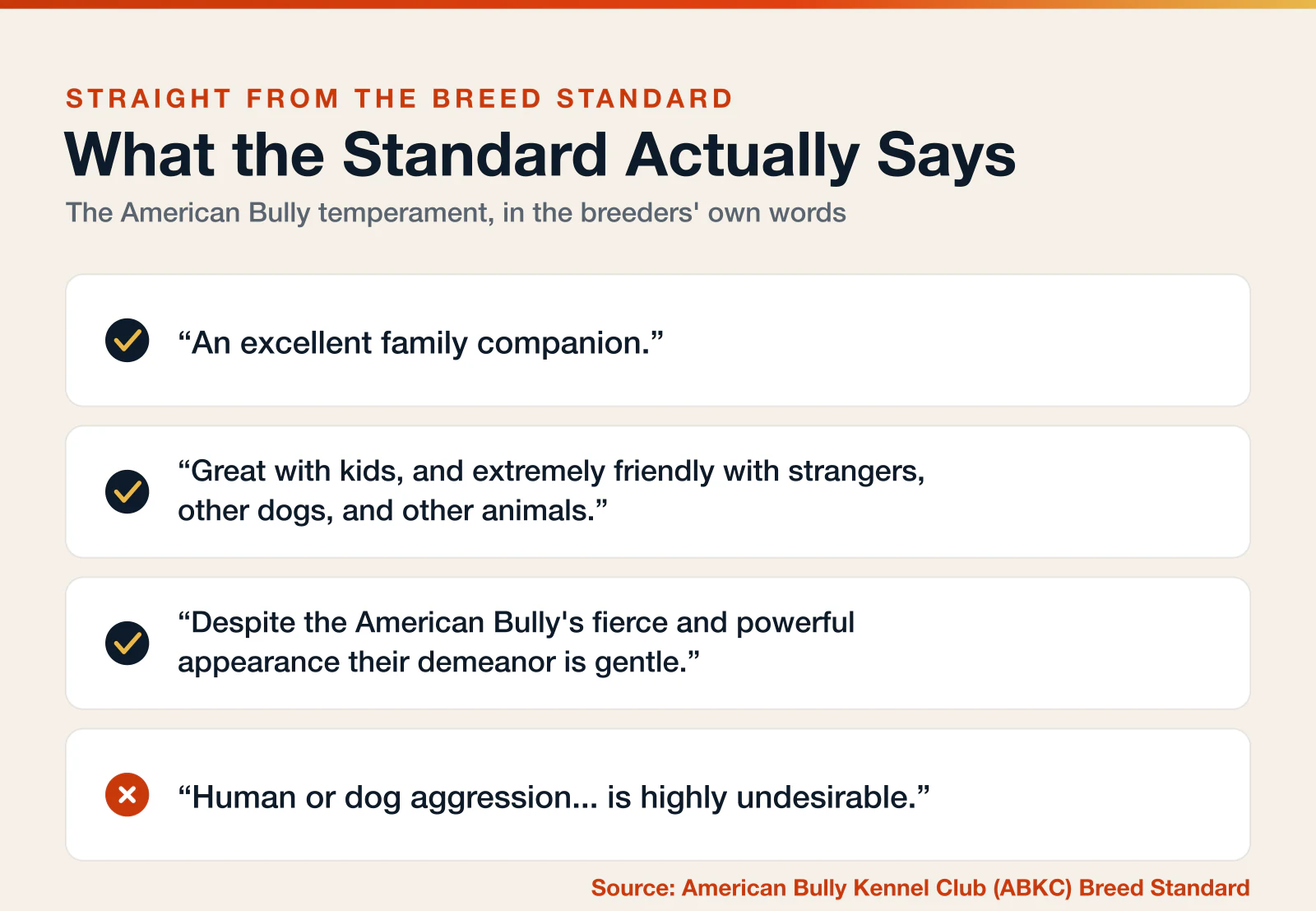
The standard calls the American Bully “a companion breed” with “an exuberant willingness to please and bond with their family,” which makes it “an excellent family companion.” It says the dogs are “great with kids, and extremely friendly with strangers, other dogs, and other animals.” On aggression it could not be clearer: “Human or dog aggression, extreme shyness, or viciousness is very uncharacteristic of the American Bully and is highly undesirable.” And on that intimidating look: “Despite the American Bully’s fierce and powerful appearance their demeanor is gentle.”
That is the blueprint. A well-bred, well-raised American Bully should be steady, affectionate, and people-focused. Keep in mind that a standard describes the goal, not a promise about every individual dog. Genetics, breeding, socialization, and daily handling all shape the adult dog you live with.
What the numbers say about dogs and children
Here is the part most breed articles skip. Across all breeds, children are the people most likely to be bitten, and the most likely to be hurt badly.
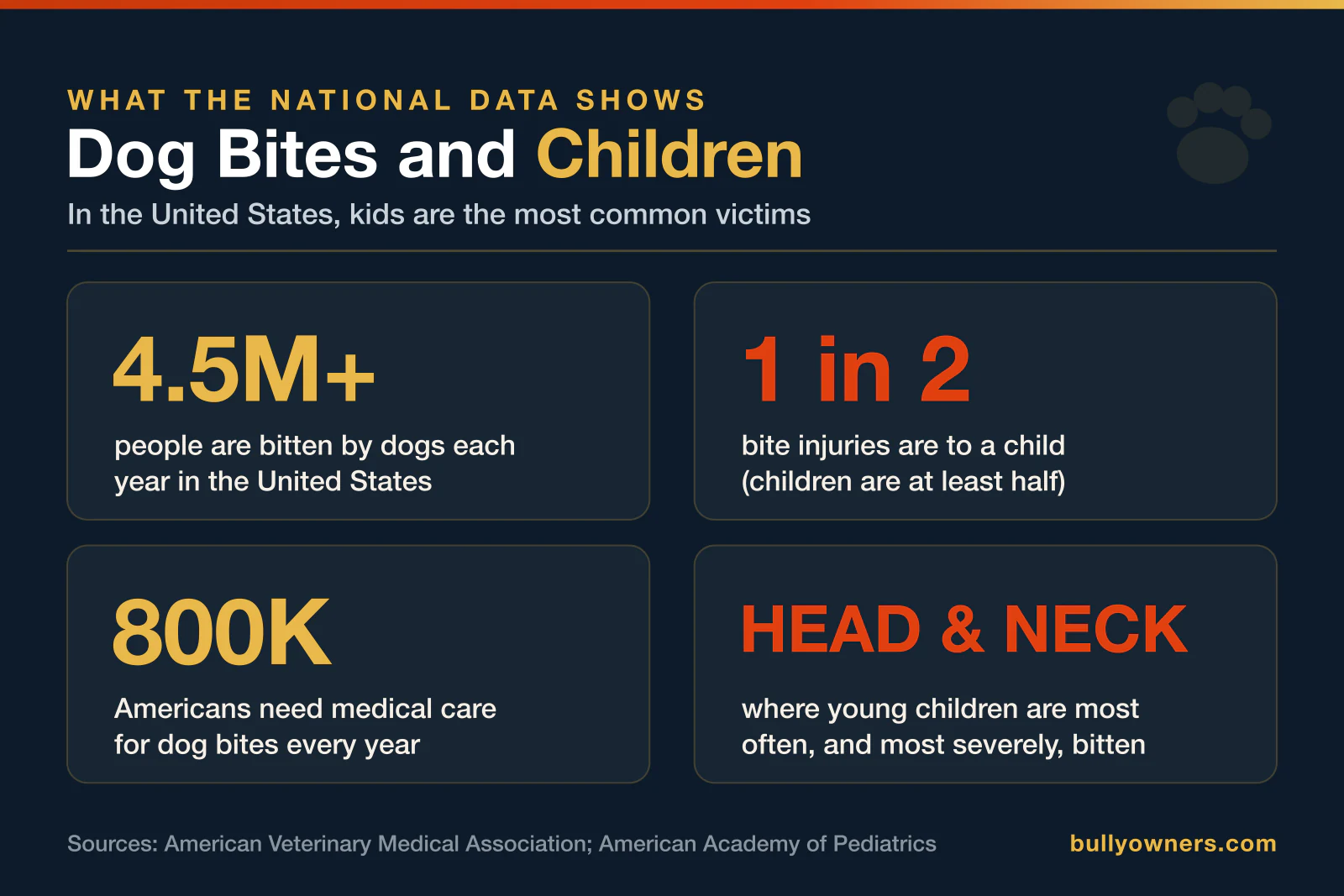
The American Veterinary Medical Association reports that more than 4.5 million people are bitten by dogs each year in the United States, and that children account for at least half of those injuries. The American Academy of Pediatrics puts it in starker terms: of the 800,000 Americans who get medical attention for dog bites each year, at least half are children. Young children are the most vulnerable, and severe bites are more likely to land on the head and neck.
None of that is specific to the American Bully. It is true of dogs in general, and it is the reason every credible source lands on the same advice: supervise, train, and teach. The AVMA says plainly that prevention focuses on responsible ownership rather than breed-specific concerns.
The “nanny dog” myth, and why it is risky
You will see it repeated everywhere online: bully breeds were the original “nanny dogs,” trusted to watch over children. It is a sweet story. It is also not real.
There is no historical record of pit-bull-type dogs being used to mind children. The label traces back to a 1971 New York Times article that described the Staffordshire Bull Terrier as a “nursemaid dog,” and advocates popularized the phrase decades later. Breed historians treat “nanny dog” as a modern myth.
A gentle breed reputation is not a babysitter. No dog of any breed should be left in charge of a child, and a calm temperament never replaces an adult’s supervision.
The myth is risky because it tells parents to relax at the exact moment they should be paying attention. Believe the breed standard about temperament. Set aside anything that tells you a dog can be trusted alone with a small child.
Supervision: the one rule the experts agree on
If you take one thing from this guide, take this. The pediatric and veterinary guidance say the same thing in almost the same words.
The AVMA: “Never leave children unsupervised with dogs. Even familiar, well-trained family pets can react unpredictably in certain situations.” The AAP: “Never leave a small child and a dog alone together, no matter if it is the family dog, a dog that is known to you, or a dog that you have been assured is well behaved.”
Notice what they are saying. This is not about your dog being bad. It is about the simple fact that any animal can be startled, hurt, or cornered, and a small child cannot read the warning in time. When you cannot give the two your full attention, put a door, a gate, or a crate between them. That is a kindness to the dog as much as a safeguard for the child.
Teach your kids the golden rules
Supervision works best when your children know how to behave around the dog. The same sources give a short, practical list.
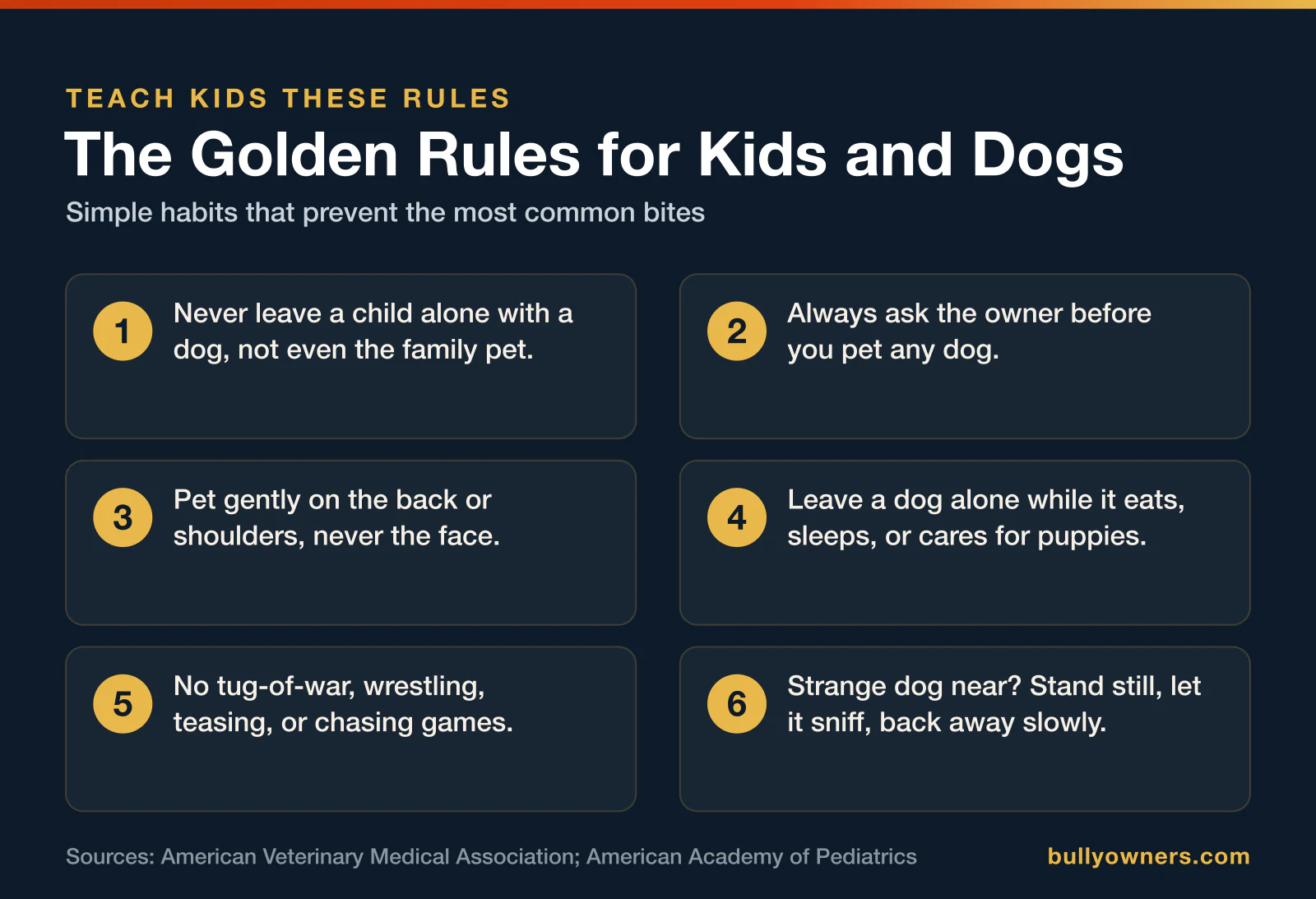
Teach them to ask the owner before petting any dog, to pet gently on the back or shoulders rather than the face, and to leave a dog alone while it eats, sleeps, or cares for puppies. Rough games train the wrong instincts, so the AAP advises against tug-of-war, wrestling, and similar play. And if an unfamiliar dog comes close, the advice is specific: do not run or make aggressive moves, stand still and let the dog sniff, then back away slowly.
| When this happens | Teach your child to |
|---|---|
| The dog is eating or sleeping | Leave it alone and give it space |
| They want to greet a dog | Ask the owner first, then pet the back or shoulders |
| A strange dog comes close | Stand still, let it sniff, then back away slowly |
| It is time to play | Keep it gentle, with no tug-of-war or wrestling |
Kids learn these rules by practicing them in calm, everyday moments, not in the middle of an exciting one. Walk through “ask first” and “gentle hands” while the dog is relaxed, and the habit will be there when it counts.
Read the dog: warning signs to respect
Dogs tell you when they need space. The signals are easy to learn, and worth teaching everyone in the house.
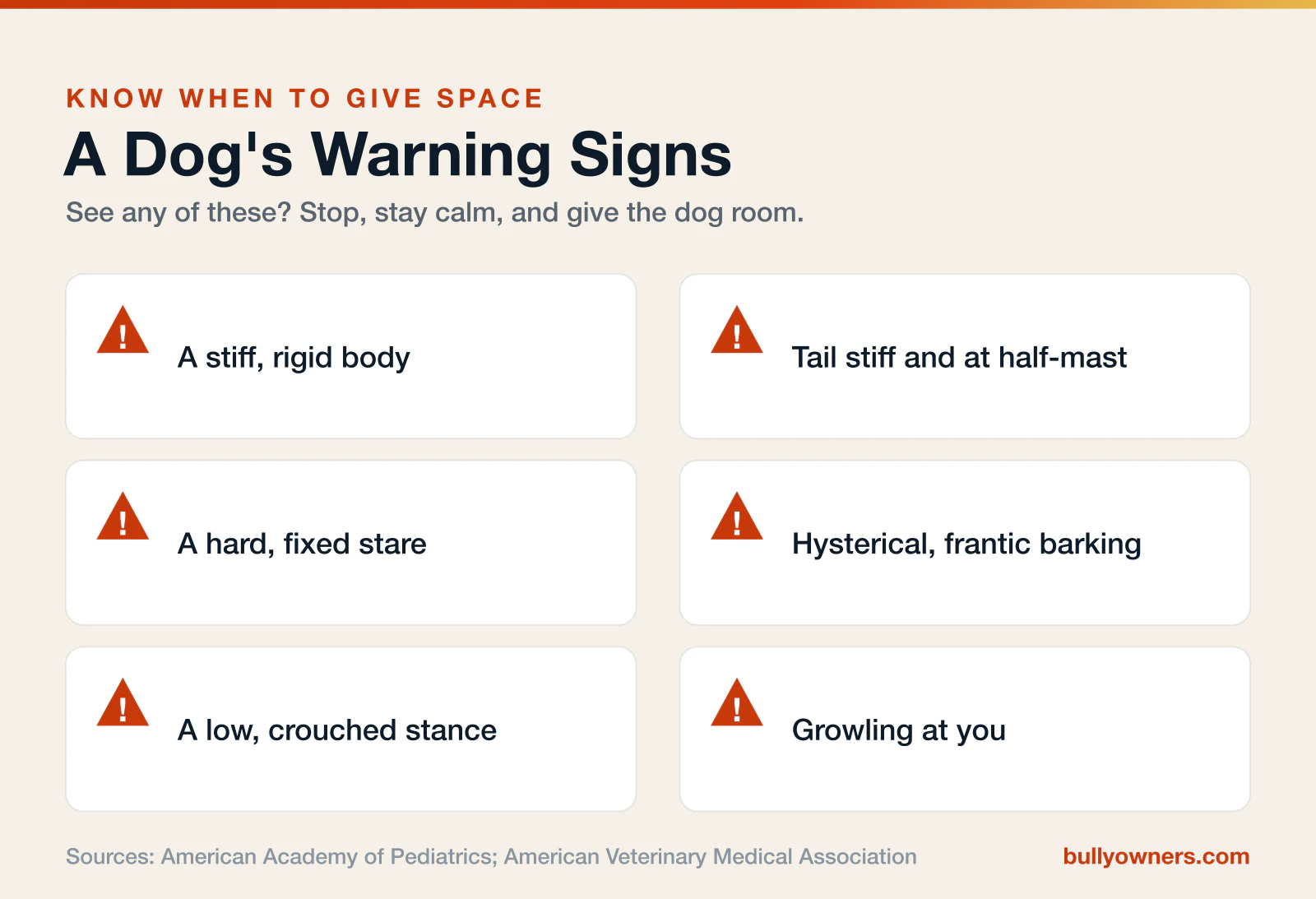
The AAP lists the body language of a dog that is not comfortable: a rigid body, a tail held stiff at half-mast, a hard staring expression, hysterical barking, and a crouched position. The AVMA adds the obvious ones, like growling and a stiff posture. When you see any of these, the response is calm and simple. Stop what you are doing, give the dog room, and let it settle. A dog that is allowed to walk away rarely needs to do anything more.
Set your dog up to succeed
A safe family dog is mostly the result of steady, ordinary work.
Socialization and training carry the most weight. The AVMA’s prevention advice centers on responsible ownership: training and socialization, regular veterinary care, and learning to read your dog. A confident, well-handled American Bully that meets the world early and often is the dog the standard describes.
Sourcing matters too, because temperament starts before you ever bring the dog home. Choose a breeder who raises puppies in the home, prioritizes a stable temperament, and lets you meet the dam. Take your time. A calm, people-focused line is the easiest dog to keep safe around children.
If a bite happens
Even in careful homes, accidents happen. The AAP’s first steps are straightforward. Wash the wound with soap and water, then call your pediatrician, because a bite can need antibiotics, a tetanus shot, or rabies treatment depending on the situation. When in doubt, get it looked at.
UK owners: the XL Bully law
If you are in the UK, the XL Bully is a legal matter as much as a family one, and the rules are strict.
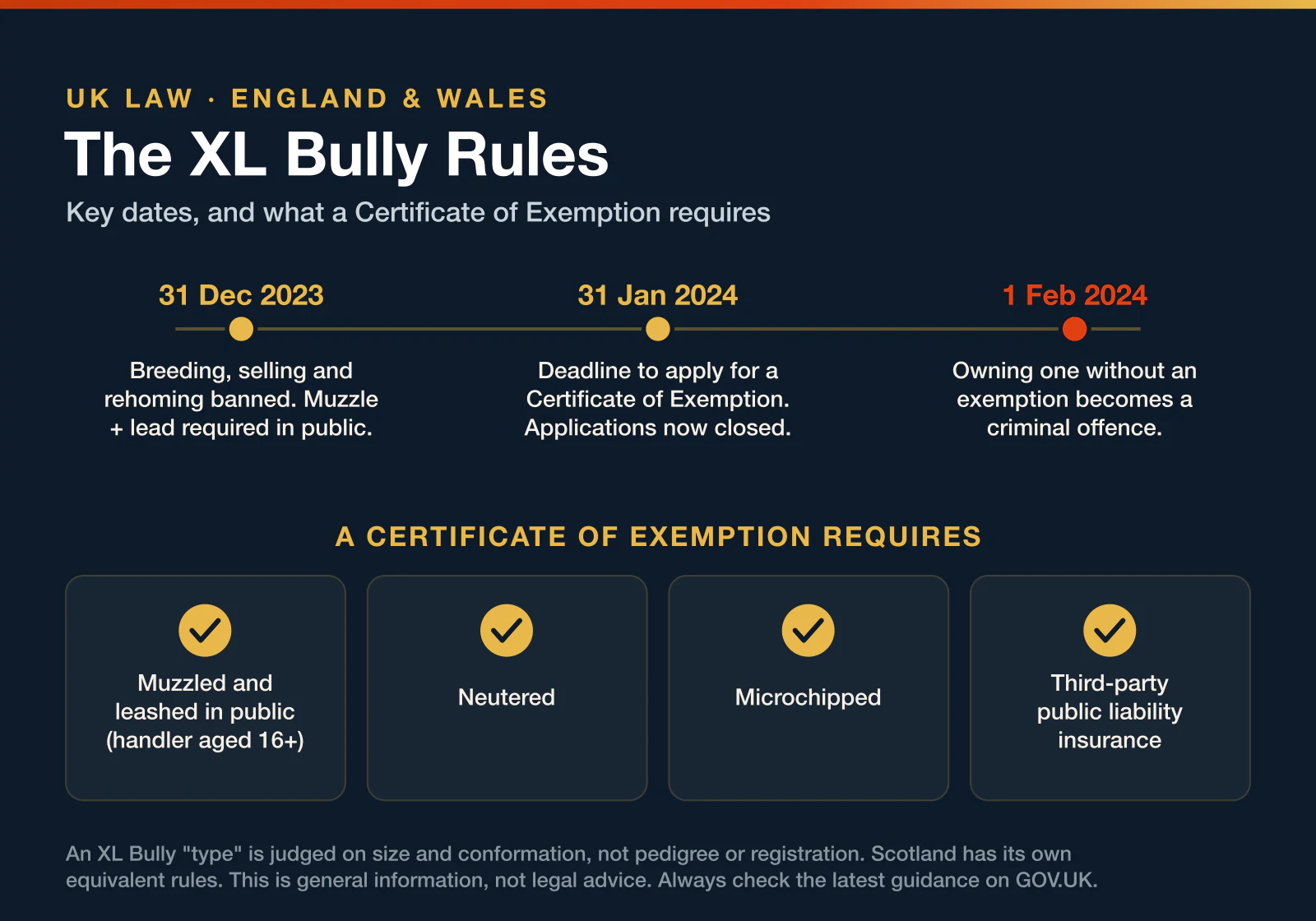
Since 1 February 2024 it has been a criminal offence to own an XL Bully in England and Wales without a Certificate of Exemption. Earlier restrictions began on 31 December 2023, when breeding, selling, rehoming, and abandoning these dogs was banned, and a muzzle and lead became mandatory in public. A valid exemption requires the dog to be muzzled and on a lead in public (held by someone aged 16 or over), neutered, microchipped, and covered by third-party public-liability insurance. The application window closed on 31 January 2024, and new exemptions are now granted only by a court.
One detail trips people up. The banned “XL Bully type” is defined by a government size and conformation standard, not by pedigree or ABKC registration, so a dog can fall under the rules whatever its papers say. Scotland brought in its own equivalent safeguards during 2024. This is general information rather than legal advice, so check the current guidance on GOV.UK for your situation.
Frequently asked questions
American Bully and children: common questions
The breed standard describes them as “great with kids” and “an excellent family companion,” with a gentle demeanor. A well-bred, well-socialized dog tends to be steady and affectionate. Temperament is the starting point, and supervision plus training do the rest.
No. The “nanny dog” idea is a modern myth with no historical basis. No dog of any breed should be left in charge of a child.
No. Both the AVMA and the American Academy of Pediatrics say never leave a small child alone with any dog, including a trusted family pet. Separate them with a gate, door, or crate when you cannot give them your full attention.
Watch for a stiff, rigid body, a tail held stiff at half-mast, a hard fixed stare, hysterical barking, a crouched stance, or growling. If you see these, stop, give the dog space, and let it settle.
Wash the wound with soap and water and call your pediatrician. A bite can need antibiotics, a tetanus shot, or rabies treatment, so get medical advice rather than guessing.
In England and Wales, owning one without a Certificate of Exemption has been a criminal offence since 1 February 2024. Exempt dogs must be muzzled and kept on a lead in public, neutered, microchipped, and insured. Scotland has its own equivalent rules, and the “type” is judged on size and conformation rather than pedigree.
The bottom line
The American Bully is bred to be a gentle, devoted family dog, and the breed standard backs that up. The data on children and dogs is the reason you still do the work: supervise without exception, teach your kids the rules, learn your dog’s signals, and source and train with care. Do those things, and you give your dog the best possible chance to be exactly the companion the standard promises.
Thinking about bringing home an American Bully?
Our complete American Bully Buyer’s Guide walks you through every class, every health check, and every question to ask a breeder before you commit.
Ready to Buy Your Bully?
Get the complete buyer's guide. Every class explained, every scam exposed, every health check covered.
Get the Guide – $17